
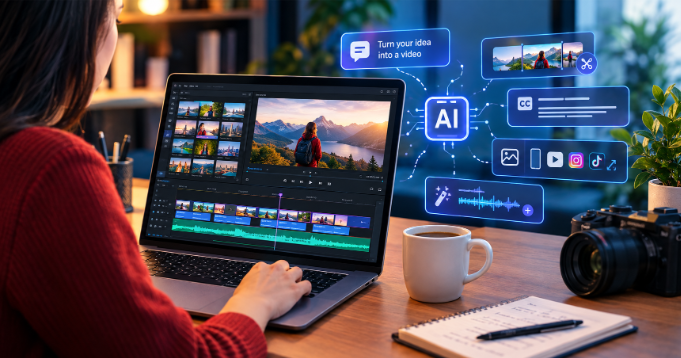
Properly producing video content can be quite the process. The editors have to watch dozens of videos, cut out the parts they don’t like, order the videos, write subtitles, store appropriate pictures, and make the final video for various platforms. But these tasks can become tedious if they are repeated on a regular basis. AI is introducing a new concept, with some of the repetitive work being made easier with the help of natural language instructions and automation. That way, video editing becomes more streamlined, but it still does not limit creativity for the content maker.
From Manual Editing to AI-Assisted Workflows
Typically, a blank timeline is the starting point of traditional editing. The creator imports files, then looks through the footage to find good clips, then edits them into a sequence over a period of time. This approach is very time-consuming and gives very detailed control, but can be very time-consuming for projects with lots of raw material.
AI-supported editing alters the point of departure. Rather than having to make all the organizational decisions, creators can outline the desired content of the footage and rely on intelligent tools to assist in structuring an initial content plan. It can be helpful when the purpose is to use unorganized recordings as a first draft.
The editor can then look over the suggested arrangement and make creative changes as necessary. So, automation is not about making decisions for people but helping them to make decisions.
Natural Language Makes Editing More Accessible
For example, directions could specify ideal video time, what pieces to pay attention to, and how fast the communication should be in a quick video for social media. The implementation of this approach may be carried out by means of a video-editing program capable of putting instructions into action and making video cuts. A ChatGPT video editing tool can fit into this broader workflow by helping translate natural-language instructions into practical editing actions and ideas.
This method can also ensure that the creation of videos is simpler for anyone who is new. Rather than formulating every editing function prior to beginning a project, new users can first come up with their creative objective, and then shape the final draft.
Organizing Large Amounts of Footage
Editing raw footage can be one of the more mundane elements of shooting video. During a single recording session, many clips, many duplicate takes, many unused scenes, and little bits and pieces can be produced that only come into play after careful consideration.
AI can help with this first step of organization by providing a more manageable starting point and identifying relevant content. This doesn’t imply that all automatic selections will be spot on. It is important that some significant scenes are still to be edited and that the chosen content is appropriate to the purpose of the video.
However, there is a possibility that by doing this, the overall process becomes efficient. That saved time can be devoted to storytelling, sound design, visual tweaks, and more.
Building Videos Around a Clear Purpose
The first step in good editing is to have an idea of what the video is supposed to do. There are so many different ways to arrange a product demo, an educational video, a travel video, and a small video for social media, even if they all have the same types of clips.
At this juncture, AI tools in workflows provide assistance to creators by making sure that they first plan what they want to achieve and then refine the specifics. For instance, an educational institution’s video-maker may be primarily concerned with tempo and logical flow, while promotional videos are more about eye-catching visuals and fast transitions.
When creating a purpose first, you can structure your editing process. With AI handling some of the production work, the human editor can then decide if it’s the right sequence that conveys the intended message.
Flexible Editing After the First Draft
To summarize, automation is beneficial to creators because they can make changes to the first draft produced by a bot. The first draft can be a good starting base, but it cannot be regarded as the final option. Edit-makers can change/replace clips, edit sequences, change their order, edit captions, and modify audio. These changes can be made using an editable workflow without the creator having to re-create the workflow.
The automated support and manual polishing are vital. It empowers technology to perform repetitive preparation tasks and maintains flexibility during the entire creative process.
Supporting Content for Different Platforms
Supporting content for different platforms exists. Increasingly, video producers are making multiple versions of the same video. A longer video may be a short vertical video for another platform, or a tutorial may need to be captioned or presented in another type of presentation for a different platform.
AI editing tools can assist in making these changes more efficient, accommodating various formats and production needs. Every version needs to be assessed separately, however, as expectations, screen size, speed of viewing, and viewing habits vary from audience to audience.
Instead of adapting the length or size of a video to the platform, it’s important to think about what the most important content is when creating a video for each. Human validation is still needed to ensure context and quality.
The Role of Human Creativity
Although technology continues to improve, there are still important components of creativity and judgment in video production. AI is capable of identifying trends, arranging the content, and speeding up the boring tasks. However, all decisions about what the stories should be about, and what their emotional impact should be, are made by the people who create them. Often these elements rely on context that is beyond a simple instruction.
Therefore, AI editing should be considered as a co-creative process. There can be production friction that can be minimized through technology, or direction, judgment, and originality that can be added by a human editor.
Conclusion
AI Video Editing transforms the approach of creators to video production. Automated workflows, paired with natural language instructions, can help to streamline footage organization, assist with initial drafts, and ease repetitive editing tasks.
The true value lies in leveraging the capabilities in combination with human creativity. With creators continuing to review, refine, and form the final product, AI can serve as an effective production assistant rather than taking the place of editing. This pairing can help both seasoned editors and novices create more efficient production lines while ensuring they have the final control over their production.
 Connie Cardillonero has opinions about investment trends in commerce. Informed ones, backed by real experience — but opinions nonetheless, and they doesn't try to disguise them as neutral observation. They thinks a lot of what gets written about Investment Trends in Commerce, Strategies for Profitability, E-Commerce Finance Insights is either too cautious to be useful or too confident to be credible, and they's work tends to sit deliberately in the space between those two failure modes.
Reading Connie's pieces, you get the sense of someone who has thought about this stuff seriously and arrived at actual conclusions — not just collected a range of perspectives and declined to pick one. That can be uncomfortable when they lands on something you disagree with. It's also why the writing is worth engaging with. Connie isn't interested in telling people what they want to hear. They is interested in telling them what they actually thinks, with enough reasoning behind it that you can push back if you want to. That kind of intellectual honesty is rarer than it should be.
What Connie is best at is the moment when a familiar topic reveals something unexpected — when the conventional wisdom turns out to be slightly off, or when a small shift in framing changes everything. They finds those moments consistently, which is why they's work tends to generate real discussion rather than just passive agreement.
Connie Cardillonero has opinions about investment trends in commerce. Informed ones, backed by real experience — but opinions nonetheless, and they doesn't try to disguise them as neutral observation. They thinks a lot of what gets written about Investment Trends in Commerce, Strategies for Profitability, E-Commerce Finance Insights is either too cautious to be useful or too confident to be credible, and they's work tends to sit deliberately in the space between those two failure modes.
Reading Connie's pieces, you get the sense of someone who has thought about this stuff seriously and arrived at actual conclusions — not just collected a range of perspectives and declined to pick one. That can be uncomfortable when they lands on something you disagree with. It's also why the writing is worth engaging with. Connie isn't interested in telling people what they want to hear. They is interested in telling them what they actually thinks, with enough reasoning behind it that you can push back if you want to. That kind of intellectual honesty is rarer than it should be.
What Connie is best at is the moment when a familiar topic reveals something unexpected — when the conventional wisdom turns out to be slightly off, or when a small shift in framing changes everything. They finds those moments consistently, which is why they's work tends to generate real discussion rather than just passive agreement.